
Trails of the Frank—are Chainsaws the Answer?
Trails of the Frank—are Chainsaws the Answer?
An in-depth look based on 47 years of experience, at the facts of trail history, condition, maintenance or lack thereof, of the thousands of miles of trails of the Frank Church River of No return Wilderness.
If you’re one of the many who have enjoyed making unenlightened comments about the recent chainsaw use rules in the Frank, you may or may not like to know the facts as they truly are. Sometimes ignorance is truly bliss, but in the end, we should all make attempts to educate ourselves on such topics before we make such comments, especially if those comments include personal attacks upon others. I realize that in todays’ world, such off-the-cuff personal attacks and emotional responses are in vogue. I would hope that most users and stakeholders in and of a place as cool as the Frank would be interested in a little education, even at the risk of it changing your opinion. Beware, facts are stubborn things, and even though I will try to stick to those facts while regurgitating those facts based on my near 5 decades in the Frank, I will unfortunately let a few of my own opinions and/or assumptions slip in.
The realities of the trail situation in the Frank are most likely way more complicated and even bizarre at times, than you are probably aware. The culprits are sometimes obvious but in just as many cases, obscure. But they all play a role. And if you think a band-aid (I.E volunteer trail crews, chainsaw use or axes and crosscuts) here or there is the solution, I believe you are sadly mistaken. If you care, grab a beverage and settle in for a slightly in-depth history and overview of the Trails of the Frank. Maybe then you can go forth with a new understanding and voice your opinions with at least enough knowledge for your comments to be valid.
This very summer in late this July, 2026, my wife and another female rider were on the final miles of a two-day 50-mile ride with a dozen head of horses and mules to our base of operation in the near center of the Frank. Unbeknownst to them, as the last of the stock rounded a cliff bound section of the trail, the entire trail bed gave way. Fortunately, all animals were able to cross the failure without incident. Fortunate yes, but this is not always the case. Several years ago, we had 2 mules fall over 40 vertical feet into Big creek as a result of the same scenario. One walked away but scared for life, the other didn’t. Both situations could and should have been avoided, but as you will see, we have become so focused on the “shiny object” of down trees (and now chainsaws) that we are overlooking the entirety of the trail situation. And it is the “entirety” that we must and will cover here.
Some History
The first trails were undoubtedly created, and still are today, by wildlife. And when convenient or necessary, those trails were and are still followed and/or improved by man. Within the Frank, the human aspect was affected not only by the folks living there, but also by those who would pass through or migrate there for cultural or survival reasons. Root gathering and salmon harvesting are great examples of reasons folks would come to the Salmon River country while others like the Tukudika made it their home. Game trails become improved human trails. Foot trails become horse trails. With mining and homesteading some became roads.
More recently, it is important to note, that the Frank and its borderlands were home to thousands of people at one time. Not just the modern, currently existing towns like Salmon, Yellow Pine or Riggins. Towns like Thunder City, Bonanza, Custer, Cobalt, Dixey and Shoup (Shoup was once considered for the site of the state capital, seems crazy now.) The area that is now the Frank became home to many who supported the efforts of these towns with food, logistics, livestock, recreation and more. The biggest boom beginning in the 1880 with the discovery of gold and silver in and around the Frank. Folks would build, maintain and even charge others for the use of some trails and roads. Ferries were built and capitalized on.
By the early 1900s President Roosevelt was aggressively bringing as much land as possible into the fold of the newly formed US Forest Service. New terms were being bantered around. Words like “Conservation” and “Preservation” were Greek to the general public of the day. A huge fire took place across central and northern Idaho plus parts of Washington and Montana at this time. Fire became the enemy of conservation and preservation of our newly created National Forests. I suggest you read “The Big Burn,” an excellent book on the topic.
It is assumed by many that the land in and around the Frank was so rugged and wild that it was only ever inhabited by the hardiest of indigenous folks and once they were removed, the humanly vacated land was easily absorbed into the USFS system, beginning as wild and rugged country, to National Forest, then being designated as Primitive Areas, and finally the Wilderness we know now. Essentially it is assumed that it started wild and remained wild and so protected as wild. Nothing could be further from the truth.
The land of the Frank actually had a period of relative extreme domestication. People lived, worked and traveled everywhere. Almost every suitable flat spot along its major rivers and tributaries has signs of modern day (post 1880) human habitation. Most of the buildings have burnt away but the remnants are there for those who care to look. Foundations, tools, farming equipment, tree scars from the era, etc. There are plenty of trees still standing beside the rivers with 100+ year old cable scars from cable car and ferry crossings utilized since the modern era.
This domestication also brought a new aspect to the trails of the area: Stock (I.E. horses and mules). It was no longer good enough to get places on foot. Trails were built and/or improved to handle stock use. Trails that once were simple improved game trails and routes now were cribbed, bedded, blasted, and engineered up to 8’ wide and tall enough to allow for a rider to pass under or through existing limbs and brush. Bridges were built everywhere, from simple primitive log structures to full-on single span steel and/or suspension types. When able, trails became roads. There were several bulldozers that roamed through many parts of the Frank area, building roads, airstrips, construction sites, farming and mining needs, and then simply heading cross-country to the next user and duty. One of these is buried at the epicenter of the Frank at Cabin Creek.
The fear of fire also brought the fire lookout system, probably the impetuous to the largest formal government operation of trail creation, improvement and maintenance in and around the Frank. Suddenly there was a need to get to seemingly every substantial peak with a view and build a fire lookout on it. These lookouts would require lumber and other building supplies, access to a water supply, part-time resident personnel, food and supply deliveries, and most importantly and probably the least known fact of the Frank trail system saga: “Communication.” It all required an extreme addition to the volume and condition to the trails of the Frank.
Fire lookouts varied in their creature comforts. Some included a comfortable modern structure of approximately 15’ by 15’ with insulated walls, roofing, large windows, woodstove and kitchenette, bed, lighting and more. Others were simply a location to look from with a wall tent pad somewhere in the vicinity. Regardless of how elaborate they were or were not, they all had several things in common. The need to be manned, have a view, and a way to communicate quickly if and when a fire was spotted. To that purpose, each lookout had a square high-top table like structure centrally located with a map/compass of the area permanently placed upon it. This tabletop and map were accurately positioned so the map was oriented perfectly with the spotter’s land to be watched. If smoke was spotted the lookout would simply turn a center dial and point it at the smoke. It would only take one other lookout to go through the same simple process for the fire to be triangulated and accurately located on a map by the personnel in town who would direct the firefighting response.
The quick transmission of these fire coordinates would be quintessential to a rapid-fire response. It was impractical to think that when a lookout spotted smoke that he or she could simply run down off the mountain and on into some town somewhere. The answer was the telephone. I can only assume that it took thousands of miles of wire to get the job done. Almost all lookouts would have a telephone wire of copper or galvanized metal run to them. These wires would interconnect with all the other wires run throughout the area. Homesteaders and other inhabitants of the area would also connect to the system. One of the drainages in my old operating area is actually called “Telephone Creek,” supposedly because of an elaborate junction box located near its mouth. In actuality, almost all major tributaries could have been called Telephone Creek as there were lines everywhere.
In many cases there still are miles and miles of this wire strung out within the Frank. While most lines would parallel a trail, many of the lines headed to the lookouts would take a more direct rout than a trail to the lookout could offer. Essentially trails need to follow appropriate routes, include switchbacks and such while the telephone wire could be stretched in a straight line anywhere, they could keep it off the ground.
The whole system relied upon the green, unburnt, dependable mature trees of the not-yet-the Frank. On occasion when open stretches or rocky treeless sections required, telephone poles would be cut and planted and/or creative rocky points would be used as well, but the green trees were what made it all possible. With these lines in place almost instant communication was now possible. Much quicker than the trail running messenger option. FYI, there would be no way this system could possibly work in the Frank of today as a result of all the fires and subsequent dead and falling trees.
The late 1920s and early 30’s brought the “Great Depression.” Wall street’s poor habits have never had a larger effect on the land of the Frank. As a result of subsequent government-initiated work programs, armies of civil servants via the CCCs, “the Civil Conservation Corp” descended upon places like The Central Idaho Primitive Area. Never have the trails been so improved, modified, extended and added too as they were during this era. Let’s keep in mind that this was nearly 100 years ago and most of the necessary major trail engineering of the day is still present (in some sort of state of functionality or another) and in most cases absolutely still necessary today. More on this later.
An interesting side note to the lookout locations is that it seems that for some reason, natural or otherwise, the majority of them had small past-burned area around them. I apologize for not knowing this history better, but it does make one wonder? We do know that when fires occurred, more armies of temporary civil servants would descend upon the public lands in the way of mercenary firefighters. Such duty typically paid well for the times and without throwing anyone under the bus, fires were many times a desired economic opportunity for the local populations, with the federal government more than willing to throw plenty of money at such events. This fact is still true today.
And then for 50 some odd years the trails of central Idaho would be jointly maintained by the USFS, local residents, periodic fire crews, youth corps, outfitters, private backcountry users and such. Airplanes begin to replace the need for an extensive lookout system. While some are maintained and utilized, others are abandoned and simply left to melt slowly into the environment. Many of the phone lines would be disconnected. Some rolled up and hauled away, while much of it still litters the ground while the trees that once supported it have died, burned or both. Suddenly, quintessential trails for servicing these lookouts are abandoned as well.
In 1931, much of what is now the Frank was designated by the USFS as the Idaho Primitive Area. They added some more land in 1936. Somewhere, somehow, I believe the “Salmon River Breaks Primitive Area was in play during this era as well. Personalities would play a tremendous roll during this period and still to this day. Simply put, the character of individual sectors of the backcountry were under the direct influence of the land-manager-du-jour. The area was littered with old abandoned cabins. From the lowest river bottoms to the highest basins, cool old cabins were everywhere with trails to and from. In the USFS, it seems, that District Rangers don’t remain in the same place for long. As a result, no matter how many rangers you have that may think old structures like cabins and lookouts are cool to just have around, it only takes one with the vision of burning them to be best, to ultimately destroy them forever. And such is the case with the vast majority of these structures being systematically burned or allowed to burn. At which time associated trails begin to disappear.
These personality traits can also have influence over what fires are put out and which ones will be left to burn. What trails will be kept open and which ones abandoned. The resources allotted and the projects to be completed. These all become primarily influenced by the priorities of the District Ranger. Obviously, his or her budget will have great influence over their desires. More on that later.
With the exception of a fire here and there which were usually quickly addressed, the trail system didn’t experience any consequential change for over half a century. Congress passed the Wilderness Act in 64’ and then the Frank came to be in 1980. (FYI, I arrived for the first time in the Frank in July of 1980, possibly on the day President Jimmy Carter enacted such). Two interesting stipulations are placed within the Central Idaho Wilderness Act. They state:
1) Such protection can be provided without conflicting with established uses.
2) In administering the River of No Return Wilderness, the Secretary shall, to the maximum extent practicable, consistent with the management plan required by this section, clear obstructions from all of the national forest trails within or adjacent to the wilderness on at least an annual basis.
These lines is a perfect example of two real truths about Congressional actions. One, they rarely can foretell the future, and two, they love to mandate without funding. In all fairness, clearing the Trails in and around the Frank pre-1980 was child’s play compared to what was about to transpire. But also, in fairness, there was a huge red flag that appeared in 1979 that should have gotten someone’s attention, fore it would change the trail maintenance saga of the Frank for the worst and seemingly forever.
In 1980 I arrived in the Frank. I worked most of the summer and fall in and around the Frank. I set camps, pulled camps, cut firewood, guided hunters and packed meat—all with stock present. In all of that time and travel, I watched my boss chop one six-inch diameter tree out of the trail. That was it. That was trail clearing for the season. My second year, 81’, I brought stock in from Meyers Cove to Cabin Creek, a 50-mile ride. When we arrived at Cain Creek there were still plenty of leftover cabins, barns, airplane hangars and other structures having yet to be burned. Caretaking the place was an older couple, presumably in their sixties but I can’t be sure. Beyond keeping an eye on Cabin Creek, their other job was clearing the FS trails of the area. Again… two folks in the 60s+.
Upon our arrival, the gentleman asked if there were any problems in the trail. The answer was yes, one tree about three hours back that was easy to go around with stock. The next day the couple rode the three hours, cut out the one tree and rode home. A few days later I was with my new boss showing him a secret (wouldn’t you know) hunting trail. The outfitter whom I worked for my first year happened to be on his last year, so now I was suddenly the guy with the most experience in the area. As we traveled down our secret hunting trail we came upon a fallen tree about 12” in diameter and lying flat on the ground. An easy stepover for man or beast and also on an out-of-the-way-secret trail. And the only one we came across. My new boss cut it out with a chainsaw. Again, the only trail clearing I participated in for that season. 2 years, 2 trees. This is what Congress had to go on. My how things have changed.
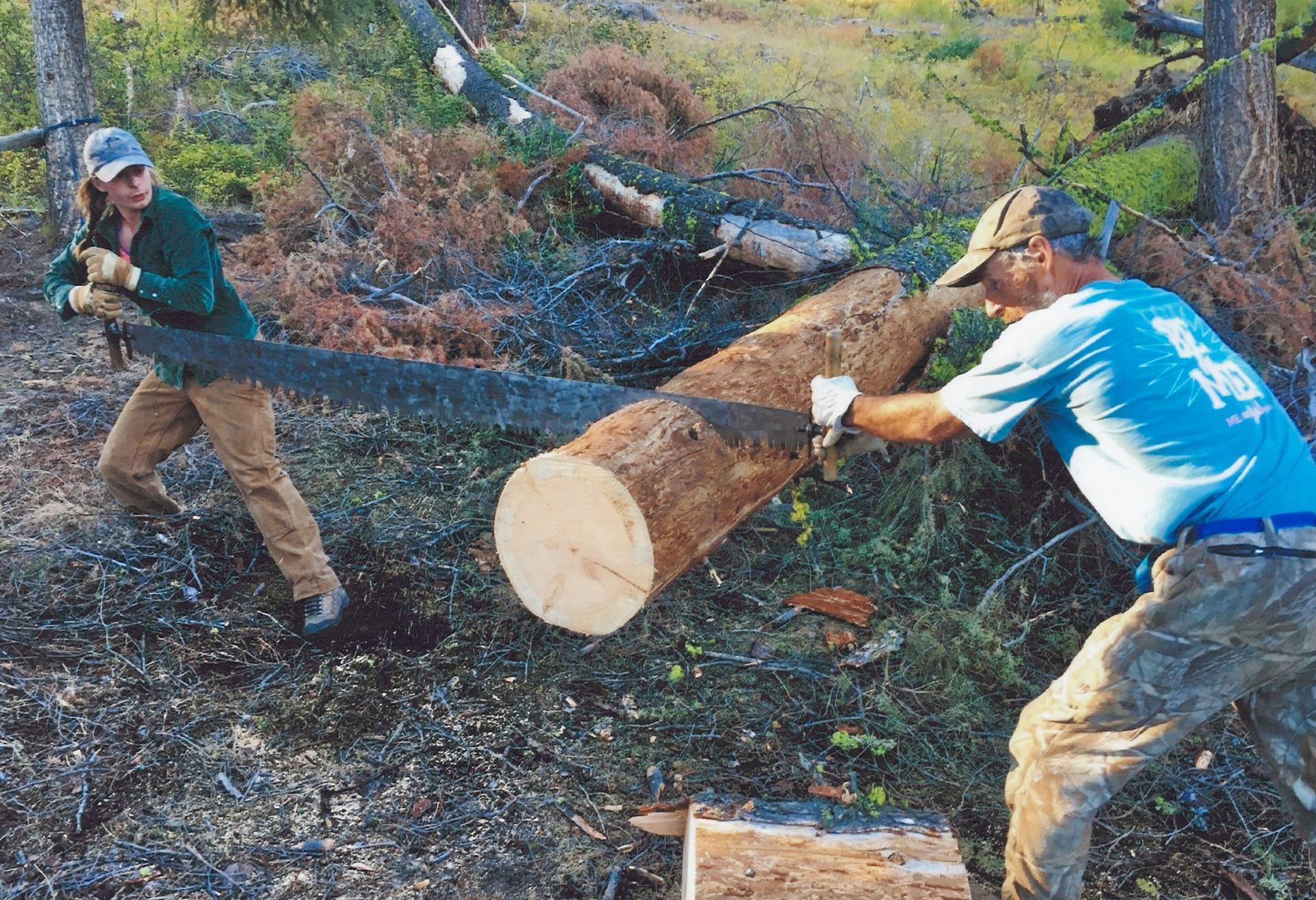
For over 20 years, all I carried on my saddle was a small double bit ax. It was mainly used to quarter elk, but on occasion I would use it to chop something out of the trail. For that purpose, it was highly inefficient. We had one and two-man crosscut saws that we could bring with us in the event of major trail issues but not on a daily basis. Suddenly, overnight, there seem to be a need to always have a saw of some sort. The 24” sheathed trail saw has become a backcountry horseman fixture, with some other specialty saddle-able saws now being carried as well.
This is an excerpt from a book that I wrote, “The Organic Treadmill and Other Great Powers of Wilderness.” It attempts to describe the new realities of equine supported Frank travel.
Back to us moving. This involved the team, Rob and I, catching, saddling, and packing all the gear, which we had to tear down and wrap up to do so. Two steadily working crew members can usually be ready to move in about two hours. That is, if the stock and the guests cooperate. We typically begin this affair in the dark so as to be ready to leave as early as possible. Moving pre-fire/beetle-kill used to be cool. Heading out the trail, with some distant location in mind, knowing your immediate trip was one-way and not having to return to anywhere in particular. Real Mountain Man stuff. Now, you just cut logs!
Being the boss used to mean you got to ride out in front, leading the way! Now it means sawing the way—little trees, medium trees, large trees. Cutting lots of medium trees and small trees in order to go around too-big-to-cut trees. And this was on the main trails, the supposedly to-be-cleared-by-the-Forest-Service-Trail Crew trails. This particular trail was and wasn’t. I cut a lot of trees. On the occasion that we had multiples down in the same area, Rob would join me.
I would like to add here that back in the day, outfitters—although sometimes egotistical and/or fanatical about needing to lead the way—would actually yield such an honor to a lesser employee, even sometimes to a rookie or even a client. What an honor indeed. This arrangement almost always occurred after a fresh, heavy snow, when the trail seemed to disappear into a white wall of snow-laden trees. Yes, what an honor indeed! At this point, the honorarium still seems to fall upon the outfitter leader (me) and his saw.
I had a route planned for the final three days of hunting, which was what we had left. The initial trail sucked. Lots of cutting needed in order to pass through. However, we would be leaving this trail for another. Earlier in the season, I had been on the far end of the other trail, and it had been cut out by the trail crew earlier that summer. Usually when they begin a project, they will see it through to the other end (or should). Therefore, I assumed that the traveling would improve. The second trail involved a consistent descent for a couple of hours (if all went well). There was no elk sign to be seen on the route thus far, so it was simply cut, move, cut, move. We were now committed to the route. With a dozen head of stock, you need water, grass, flat-ish ground to camp, and you need it preferably before dark.
Down we went. The initial part of the descent was on an unburnt, somewhat timbered ridge, meaning we could detour at times if fallen trees got in our way—and they did. It was not looking good for the whole “they will see it through to the other end” assumption. Eventually, the trail would reach bottom-ish country. There would be no more meandering, as conditions kept us pretty well restrained to the trail “proper.” This also included recent burn, creek crossings, giant dead spruce, firs, and pines, head-high brush, and steep erratic trail (much like that of your favorite roller coaster, if roller coaster tracks were covered with sporadic horrendous acts of God!).
It was now obvious that the USFS trail crew had not followed protocol. The loaded stock had leapt several large, waist-high dead trees on downhill portions of the trail. There would be no leaping back up. As horrific as it was, almost as if through divine intervention, we were able to negotiate the monster logs without the need for the big saw!
When I began in the wilderness of 1980, guides carried medium sized axes on their saddles. You can do a lot with an axe, right up until the handle fails or the head falls off. With that said, the axe served its purposes well. Chopping out the rare fallen tree, quartering an elk, chopping the antlers and skull plate from the head of a buck or bull, and much like your Hat and your Chaps, just all-around helping you to look cool on your saddle.
An axe just doesn’t cut it anymore (there may be a pun or reality intended). There is just too much trail clearing necessary for the axe alone. We are also dealing with the national ungulate crisis of Chronic Wasting Disease (CWD). CWD mandates that we not deal with the spine, and so we remove the meat from the spine instead of the old “chop it down the middle” routine. With all that said, the axe has been replaced with the 24” trail saw, and most of us now carry one (although we still always travel with a big axe, in case the big saw gets stuck). And not just to look cool. We use them continuously. Just because a trail has been “cleared” today, it is no indication of its condition tomorrow. Dead trees fall over and, as we have learned since fire, so do live ones.
We cut countless trees, limbs, brush and such with our saddle saws. On occasion, we need the big saw. We avoid it like the plague, however. It’s one thing if your mission is to clear trail. If you are just trying to travel trail, the time and effort involved in the big saw just isn’t conducive with getting somewhere. But sometimes it just can’t be avoided. Big saws are dangerous; five to seven-foot crosscut saws are tricky to pack on a horse or mule. When the need for one is required, it typically means a big log in a bad place (also extremely dangerous). Oh, did I mention? They are extremely sharp (or should be). Important to note here: a dull crosscut saw that won’t cut wood still has the capacity to cut human flesh surprisingly well.
I cannot over-exaggerate the hellish nature of the trail conditions we were encountering. But there is always a paradigm shift when such experiences are had. Typically, when clients experience a normal day in today’s Frank (it being just another day at the office for guide and outfitter), their take is that of a constant battle with the natural powers that be; Hell, if you will. But, in those moments when it is truly Hell (at least from the perspective of the guide/outfitter), the clients seem to fall into a world of curious complacency. One really good reason for this shift is that, on a normal day, the time is spent at outfitter/guide speed, with the client in a perpetual state of keep up!, which is how it should be. When Hell arrives, it typically equates to outfitter/guide battling the onslaught of elements (much like that of Jackie Chan in a multi-front assault) while the client now relaxes, grasping saddle horn in a far-off, majestic pondering expression. Payback can be tough.
At this point, I was Jackie. Rob was doing what he could to help me while also dealing with loaded mule insanity. Remember: everything is downhill, and gravity is at play, and it always wins. Just because I stop doesn’t necessarily mean that 15-thousand pounds of horse, mule, and gear does. It just keeps coming. I do often wonder what the clients are thinking at a moment, or on a journey, like this. I, for my part, know what awaits us if and when we get through Hell; they don’t. They came for an elk hunt. I’m not sure what this is. For me, it is an elk hunt, for I know where I’m trying to get to, and this calamity is just a reality of getting there. But for them, it’s just insanity—and that, it is! Client indicators, including their facial expressions, conversations amongst themselves, and screaming, give us a clue. I have always been a fan of the camera. If folks are taking pictures, then they are probably in a positive state of mind. Unless, of course, they seem to be simply documenting for upcoming litigation. Should this be the case, it would be difficult to discern.
And there it was. Somewhere between my roundhouse left and my back-kick, I saw a sawed log! Not just any sawed log, but one that had obviously been sawed the previous summer. We had made it to cleared trail (a relative term, as noted earlier). Just like that, we were traveling again. It is amazing how quickly a mindset can change. All those disparaging words used in reference to the trail crew were replaced with accolades as we strode by sawed log after sawed log on our horses (with majestic, pondering expressions).
There are times in our lives that we witness things that are totally preposterous, inconceivable, and just don’t make any sense regardless of how you look at it. Such events are commonplace once we have a spouse, have children, or become employers. But you don’t expect them on your recent reprieve from Hell. Still, there it was, and it was one of many more to come. Amongst the herculean efforts of the trail crew’s giant sawed logs, impenetrable over-the-trail brush, fire-caused chaos—someone on the crew had taken real time to trim the trail-side limbs from a knee-high Charlie Brown Christmas tree growing out of the edge of the trail. (To give real perspective here, this would be like if your house was fully engulfed in flames, and you stopped to clean the toilet as you searched for your children and pets.) These trees will all be gone to the history of the trail. There are thousands of other saplings growing in the immediate area. Some will need to be removed for the sake of the trail corridor, while others a foot away may live to be 300-years old.
While his compadres were covered in dirt, sweat and ash, wrestling with overwhelming natural forces for hours and days on end, here sat someone with a pair of nail clippers trimming a half dozen spaghetti noodle limbs off each sapling. I don’t question the fact that some ignorant nincompoop thought they could save the wilderness and its forest by trimming these trees so. It’s the fact that others on the crew were busting their asses while this person was doing it, and didn’t seem to address the issue. We can only hope that someone had their helping toddler along, but I think it extremely doubtful. This, my friends, could only happen on, with, or by way of the Federal Government!
Recreation
The past 100 years has seen a tremendous amount of recreation within the land of the Frank. Recreationists get everywhere or at least wish they could. Such public desires resulted in the creation of horse trails to many of the cool spots. One only need to visit the Bighorn Crags and witness the unbelievably labor-intensive trail system that was created for folks to access the local lakes to understand. More cribbing, blasting, engineering, bridges, signage, campsite improvements, etc. Swampy areas would require a technique of corrugation, where countless short poles were cut and place side by side perpendicular to the trail in order for man or beast to be able to walk the trail without sinking into the mud.
Whereas your typical summer recreationist would invade in substantial numbers each year, their typical use was fairly predictable. They would mostly key on the lakes and the large tributaries, and whether with backpack, pack goats, llamas, or horses and/or mules, they would mainly utilize the most direct trails to get them there. Even those who were making grandiose loops or point to point trips, were generally following the blazed USFS trail system. FYI, the “blaze” consisted of a tree’s bark being marred in a consistent pattern, typically with a couple swipes of an axe about head-high above the ground. The “mark” was what was explained to me to resemble that of a candle lighting the way. A vertical scar several inches wide and upwards of a foot tall with a smaller, several inch by several inch scar a few inches above the vertical scar. Thus, looking like a candle and flame. This blaze would be repeated on both sides of the tree. If a trail was blazed correctly, you could see the next blazed tree from the blazed tree you were at. Enter the horseback hunter.
For well over a hundred years horseback hunters have come to the land of the Frank in numbers at times that are truly hard to comprehend. Stories of 70+ rigs at one trailhead on opening day of elk season, with rigs seemingly coming from every state in the union. And whereas summer folks got everywhere by trail, horseback hunters simply got everywhere. And also, whereas we can attribute the CCCs for the vast amount of lasting trail engineering, it is these hunters who created the bulk of non-officially blazed trails within what is now the Frank.
Trails to the secret camping meadow, the short-cut trail to the good hunting ridge, the good meadow, the good rock. Short-cut trails to connect short-cut trails. Elk are big, and the meat must be packed out. If you can get the stock to the dead elk, you do, almost regardless of the effort to do so. It’s a stockman thing. Elk were of tremendous numbers at times and they created wonderful game trails for stock users to follow. With little effort these trails simply became more secret hunting trails.
Many situations did not require a trail. You needed only to follow a general route down an open ridge, through a chain of meadows or just cross country when the terrain and or deadfall would allow. I am good at very little beyond napping, but as an experienced Wilderness stock user of 47 years, I am as close to an expert as exists, of abilities to travelling the Frank with horse and mule without a formal trail to do so. Those days are over within the Frank, at least at anywhere close to the levels pre-1990.
Every year, these hunters would arrive with not only their stock, gear, friends, weapons and hopes, this annual Wilderness army also sported axes, saws (many with chainsaws) and most importantly “drive” and the manpower to back it up. Do not underestimate the force and will of a horseback hunter, especially that of a guide or outfitter (regardless of age). The effects of this force can be very tangible if we simply note the actual work done. But there is an even greater effect, or at least was in the past, that doesn’t exist anymore. And the negative effects on the trails of the Frank since that loss cannot be quantified.
Wolves
Wolves were reintroduced into the Frank in 1996. As the wolves propagated and took hold, the Idaho Outfitters and Guides Association (IOGA) in 1999 hosted what was dubbed “The Predator / Prey Symposium.” All interested parties had their chance to provide input on Wolf reintroduction, including the US Fish and Wildlife Service, Idaho Fish and Game (IDFG), IOGA and others. In IOGA’s presentation we predicted that the elk herds of the Frank would crash in about a decade. Our prediction was based on wolf history and common sense. Wolves love to eat elk calves, no argument there. Elk live about 10 years on average. So, it didn’t take a rocket scientist to calculate that if few new elk were around to maintain the population, and the ones that were around would be gone naturally in ten years, that something bad would happen in about 2008-9. Low and behold, almost to the day, elk numbers within the Frank dropped by 80%. Experts still want to disagree on why this really happened, and for the sake of staying on track here, let’s just agree that based on IDFG numbers that it did. Regardless of your personal stance on wolves, their effect on the trails of the Frank are substantial.
Remember the Force, the will, the efforts, the drive of that annual army? Well it came to an end. It didn’t take long for personal experience and bad press to equate to a drastic drop in backcountry elk hunting. The biproduct of this was way more than just the vacuum of tangible trail work. When that many folks count on usable trails on a certain day, every year, without change, the powers that be are somewhat obligated/forced even, to acknowledge such. In this case, USFS trail maintenance was certainly affected by this annual need. And because of the national nature of the participants, the pressures put to bear upon the local land managers could be extensive as well, especially if they did not perform. Simply put, hunters and hunting outfitters had no problem complaining to the USFS locally if trails were not open in a timely manner. If the local complaint fell on deaf ears, the players had no problem moving up the FS ladder and/or congressman and/or senators as well. Remember the will of the horseback hunter? It is real. And regardless of your views about horseback elk hunters, their positive effects upon the trails of the Frank tangible or otherwise are all but gone.
Losing this annual force that would annually clear trail literally and metaphorically has certainly diminished the trail system of the Frank. But they are only the amateurs, so to speak. There for a week or two, and then gone, with no real long-term vested interest beyond hoping to return the following year. What about the professionals? Since wolf introduction, most land-based operating areas within the Frank have doubled, tripled or more in size just to allow survival of the business. These increases typically do not also reflect elk hunting client number. It’s really just the opposite.
If we use my operation as an example: pre-wolf I would take approximately 35 elk hunters per season. I have added to our country 4 different times now. Those business purchases would/should/could reflect upwards of 35+ additional elk hunters per season. I now take about 12 elk hunters annually. That’s right, 35 + 35 = 12. So, in an area twice the original size I’m taking 83% less hunters.
To accommodate the remaining 17%, I cannot afford the 12+ personnel that use to be needed to accommodate the 70+ hunters. My average staff for elk hunting now averages between 3-4. That equates to 8+ professional Wilderness employees who are no longer roaming the trails within my operating area, and clearing trail as they go. And, because our operating areas are so large now, greater distances must be covered by this skeleton crew. You might think that more miles of trail traveled would equate to more miles cleared. Once again, just the opposite is true. There are only so many hours in the day, and those trail hours are spent with less crew at a time, meaning simply, if possible, detouring is most likely the first option for successful timely travel. Trail maintenance most likely will have to wait. Now spread this same scenario across the entire Frank and you suddenly garner a massive void in the trail clearing saga.
Fire
In the summer of 79’ some campers had a fire get away from them in the upper end of the Middle Fork of the Salmon. In no time it became what I believe was called the third largest fire in Idaho’s history. Regardless, it was big. It encompassed nearly 40 miles along the river. As we would all learn, that yes, fires are devastating while burning, but once out and the initial damage is assessed and dealt with, (I.E. clearing burnt logs out of the trails), they can actually allow for exceptional cross-country non-trail travel for a period of time. In many cases you can simply get on your horse and ride anywhere you wish. It turns out that you have about ten years.
There is another post-fire reality that cannot be ignored. Fires cause destabilized earth depending upon the degree of intensity of the fire as it passes through. Sometimes superficial while other times it scours every bit of earth beyond the sand, gravel and rock itself. When this happens, the land becomes ripe for catastrophic land and debris slides. When a rainstorm or avalanche happens, everything in the path may and will come down the mountain, clogging, even eliminating the trail itself. Bridges get taken away as well. Thousands of tons of material, trees, rocks, dirt. In moments, an area can go from peaceful and passible to the sight of some sort of mega-bomb being detonated. Congress in 79’ missed this one completely as they did the effects of the fire era that had just begun.
In about nine or ten years after a fire, for whatever reason, almost on cue, half of the burnt trees will fall over, and continue to do so seemingly forever. Oddly some trees seem to want to stand forever. I know of some fire killed trees still standing 70+ years later. These are the anomalies as the rest have fallen. The ability to travel anywhere quickly becomes the inability to get anywhere. With the right wind, thousands of trees will topple in unison in seconds. Everything from individual giant Doug Firs and Yellow Pines to carpets of skinny Lodgepole Pines. One moment the trail is somewhat clear, the next, a maze of burnt wood, sometimes for miles.
And so it was that fire, while kept at bay for many decades, suddenly became an incalculably substantial factor in the present and future condition of the trails of the Frank. In my operating area alone, 88’ brought us a fire bigger than the one in Yellowstone. Another in 90’, again in 92’ The massive 2000’ complex with smaller ones somewhere interspersed on an annual basis to the point that I believe it honest to say that we have more burnt country than unburnt. This same scenario has played out across the Frank. If it’s summertime there’s probably something burning as you read this. I really can’t think of an appropriate analogy that would put into perspective the current trail maintenance requirements as you would compare them to those pre-Frank. Maybe something like comparing having an ant walk across your kitchen floor, to that of your home being at risk of collapse and condemned from termites. It basically cannot be over-exaggerated. Obviously, fire can be natural and inevitable, but that is not the point here. We are talking about the trails, and if fire is inevitable, and trail maintenance is mandatory, then obviously something has to give.
Beetles
Whereas fire can be natural, I’m not sure where the beetles fit in? But they are killing trees in massive numbers and have been for decades. They certainly seem to be indiscriminate, but almost criminally seem to prefer big, old, majestic Douglas Fir trees. It can be heartbreaking. Areas that somehow avoided fire are now areas of standing and fallen giant firs. Again, making the area impassible and dangerous at times. Campsite become unusable for the threat of these massive trees coming down at any time. Ridges, sidehills and creek bottoms that used to provide beautiful passage through such growth are now just tangles masses of dead wood. When this occurs along a USFS trail, the maintenance becomes almost endlessly daunting. A trail crew can spend weeks on a section only to have it completely impassible days later. Whether by fire or beetle, when these trees are encountered by your typical Wilderness traveler, they are generally way outside the practical realities and general safety barriers of being cleared with the basic tools carried by such. These trees often necessitate professional tools used by said professionals. To ask more of the common passer-bye is absurd.
In the Biz, we call these trees, “Forest Service trees.” It’s not that we are not capable of clearing such. Most land-based outfitters within the Frank have such skills and tools. The issue is time and priority. If I leave for a day of trail clearing with a crew, that’s one thing. If I have a fully loaded pack string and without help, short on daylight, confounded by weather or obligated to meet someone or something (I.E. an airplane), my priority is to simply get where I need to go. So, if a detour is possible, a detour it is. We do however tackle the smaller stuff continually. “Stepping over” has become a real thing. Remember my old boss with the illegal chainsaw and the 12” log on the ground. Such an action is ridiculous to think about now. Essentially, if you can step over it, it actually doesn’t exist. At least in our book at this time. Especially with the difficulties of cutting a tree flat on the ground with a two-man crosscut along with the possibility of sticking a sharpened saw into the dirt and rocks. Someone with a chain saw might think differently.
A little side note for perspective. In 1982 I went to work for an outfitter on lower Big Creek because the rumor was that he was ready to sell out, and at that time I knew I was ready to buy in. My first day on the job, I packed camp gear up to a favorite historic outfitter camp. The site was full of massive Doug Firs, everything green and lush. Tent pads were located strategically between the trees. It was beautiful in every way. My second day on the job my new boss handed me a chainsaw and said to cut a season’s worth of firewood for the camp while he and his wife went for a two-day visit of a neighboring area. He directed me towards the only dead trees he knew of in the area which were no less than 400 yards strait uphill from camp. I did as I was told. If you were to visit that camp today, it looks like an abandoned logging site. Giant dead trees lay on the ground everywhere. Some cut down to prevent them from crushing tents and sleepers. The place is a dustbowl with very few green trees left. All a result of beetle kill.
Brush
Ceanothus is a prevalent brush that grows heavily post-fire within the Frank. It has an annoying habit of originating on the uphill side of the trail yet with a desire to be on the downhill side of the trail. It simply grows up for a few inches, then horizontally across the trail, then up again. Miles and miles of Frank trails are unusable because of it. You can see the trail, follow the trail from one side or the other, you just can’t stay on the trail. Clearing this brush to make said trails usable takes specialty tools such as pruners, and lots of physical labor, and requires annual maintenance to keep it at bay. It can be and many times is literally worse than deadfall.
Berry bushes, alder, wild rose, saplings, post-fire evergreen regrowth, horizontally growing limbs and such have all infiltrated the trails of the Frank. Where a horseback ride 40 years ago would have involved a lovely, even possibly shaded saunter up the trail, it has more often than not been replaced with scorched earth, blackness seemingly everywhere, and obstacles that make the rider appear as if he or she are in a scene from the Matrix. Constantly ducking, leaning, pushing limbs here, snapping some off there. The definition of “trail clearing” has conveniently changed to cutting wood and possibly rolling some rocks. Tread work, brush removal, passible for stock use, width and height requirements and more have all been replaced with the mentality of “just cut it open.”
Green Trees
Fires are natural, yes. But that doesn’t make them any less heartbreaking at times. Almost worse is when the surviving trees tip over. And there seems to be an abnormal number of green trees failing within the Frank in recent years. Why?—I do not know. Many are simply tipping over, which could be chalked up to destabilized earth, but just as many seem to be breaking off mid-trunk.
We have a camp that is about a three-hour ride from the airstrip. The first two hours involve climbing a previously beautiful timbered hillside that has been replaced with thousands of burnt dead trees. Near the top and during the last 40 minutes of the trip, you finally enter beautiful mature Douglas Firs. About four years ago, some natural event caused half of the green trees to fall over. Many across the trail. Heartbreaking indeed.
Over a decade ago, during prime floating season, a large Douglas Fir treetop fell into the Middle Fork of the Salmon River. It had broken off as a result of a fire. It caused a week’s worth boating accidents and finally a fatality. It had been passed by the USFS River Patrol, USFS Fire Fighters (with chainsaws), countless outfitter and guide crews, and the same number of private boaters. For reasons Greek to me, no one seemed to have the presence of mind or the desire to remove this extremely dangerous obstacle. The government response was that they were not allowed to. Oddly, I’ve heard from USFS officials that navigable waterways were to be treated as trails. If that tree were in a trail someone would have removed it.
Right or wrong, legal or not, the common-sense thing to do was to remove a hazard that was going to cost more lives and/or equipment. On my first pass through, myself, a son, a niece and a surrogate uncle removed the treetop without difficulty, and secured it to the bank to await the next year’s high water. To this day, the argument still exists whether to treat the river corridor as you would any other trail?
Regardless of the ruling of that tree and others in the river, green trees are just more difficult to deal with. Their limbs tend to stay connected when they fall, leading to additional cutting. And they tend to tangle and intertwine leading to more cutting. And, everything about a green tree is just heavier as well. And, when you deal with a green tree you will most likely be wearing its sap like a Wilderness tattoo for the remainder of your journey. Green trees just are not that much fun.
As much as we anticipate and enjoy regrowth following a fire, those little Christmas trees that decide to sprout within the confines of a trail can be an absolute nuisance. And if a trail goes unmaintained during the wrong cycle, you can seemingly have miles of trail disappear and gobbled up by a proverbial Christmas Tree farm.
Stock
Which brings up another major issue facing the trails and trail maintenance of today. The lack of stock knowledge amongst trail crews and land managers. A cleared path is way different than a usable horse trail. It takes constant engineering and equine knowhow to keep a trail equine-safe. It takes a lot more then an ax and or a saw, chainsaw or crosscut.
The loss of need to supply fire lookouts, the dwindling budgets of the local Ranger Districts, the loss of the horseback elk hunter, the drastic reduction in recreational summer stock users as a result of unreliable trails, the lack of priority put on the equine realities of USFS trail clearing, and the subsequent innocent ignorance of the trail crews themselves, are just some of the reasons for the evermore dangerous and diminished equine-able trail system of the Frank. In addition, trying to support trail crews with stock is a thing of the past, for both realistic and possibly philosophic reasons.
In the old days, a horseback trail crew could plan their days of travel, where to get water, stop for lunch, where to spend the night, with good camping for crew and grazing for the stock. This was possible because you were unlikely to find any surprises along the way. Water bars and other tread work could be done as time allowed. Such preplanning is simply impossible now. A trail crew now simply has no idea how long, how far, how much, or how involved their route might be. They can’t even count on a route done just days before to be open today. Having to then worry about the daily and evening issues stock present just exacerbates the challenges.
Trail crews without equine knowledge make lots of mistakes. They work extremely hard, but often times the work is done incorrectly, and unfortunately often enough, could have been done correctly for no more effort if only someone would have prioritized such in their training. Stock do not think as people do. It takes experience to know how stock will react to trail issues differently than people. Someone without such experience will look at a unique trail situation from the perspective of a human, assuming that a horse or mule would think the same. Such ignorance can, has and will be fatal for stock and possibly rider.
A perfect example of this occurred several years ago. The lack of response and ignorance of the FS cost us our favorite mule and family friend. For many years and still counting, we have been complaining to the Krassel Ranger District and all of the tiers of supervision above, about the destabilization of the main Big Creek trail. Most of the engineering is nearing 100 years old and is failing. We had a place where the trail would go out onto a point/cliff some 40+feet above the creek. The ancient trail cribbing was failing at the apex of the most vulnerable point. Countless times I would carry large rocks, logs, stumps, basically anything I could find to force the stock away from the edge. It’s an old simple stock user trick and works quite well. These items rarely lasted as I’m sure that unknowing trail crews would consider them trail hazards and simple shove them off the cliff. Again, stock don’t see hazards as we do. They don’t know that a trail is undermined, unfortunately at least not until it gives way. Which it finally did.
Not all equine ignorant trail crew issues are fatal or even dangerous, but important just the same. Pack animals with loads can be much wider than folks realize. So, often logs are cut just out of the trail bed, when they should have been cut several feet back. The real unfortunate aspect to this is that if done correctly the first time, it would not have required anymore effort. Moving the saw left or right on a log needing to be cut rarely yields much additional diameter to cut. In actuality, 50% of the time there will be less to cut. Cutting it too close to the trail not only blocks the trail but also requires someone(s) to do it again.
As stated earlier, many times stock users will create detours around fallen trees when time, manpower or equipment don’t allow for clearing. The issue becomes when the trail crews continue to utilize the detour rather than clearing the obstacle. Some of these detours have been ignored for decades, with some having more trees cut to utilize the detour than just cutting out the original tree. Place this scenario on a sidehill trail and instead of a steady grade of the traditional trail, it’s a constant series of ups and downs. A man walking up a trail has no perspective of the height and width necessary for a man to ride a horse up the same trail. As a result, most trails in the Frank are not currently what you would call stock user friendly and, nor in many cases, safe.
Without a doubt, nothing creates, improves, or perpetuates a trail like continued stock use. The effect of the loss of stock use on the trails of the Frank and the subsequent diminished quality in those trails cannot be overstated. Foot traffic will only preserve the trails if continual manual tread work is done routinely.
Salmon
Salmon have played a huge role in trail priorities over the past three decades. This is an excerpt from a piece I wrote years ago called “Welcome to Salmon-less Idaho.” I believe it paints a realistic picture of the curious nature of the relationship between the National Marine and Fish Service (NMFS) and the USFS, endangered salmon and the trails.
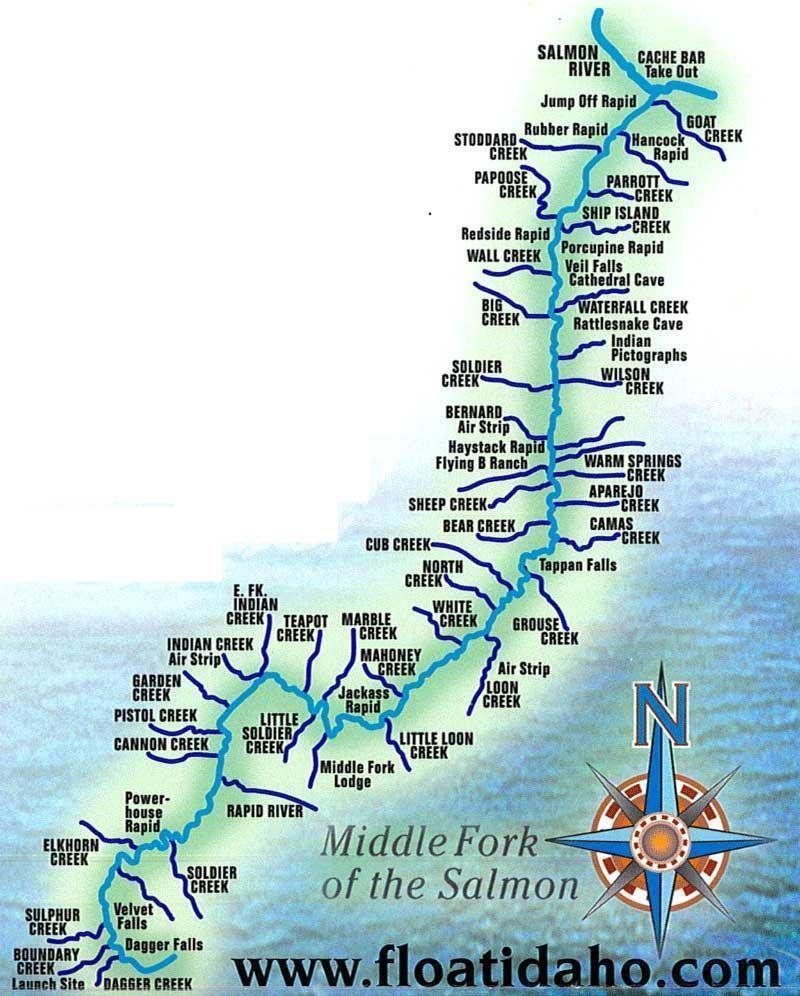
Another wonderful example of the gross misconduct associated with this myth called Salmon Restoration, is located on the beautifully wild and remote, Monumental Creek. Monumental Creek is the largest tributary to Big Creek, which is the largest tributary to the Middle Fork. I would guess that Monumental Creek is over 40 miles long with the lower 25 being within the wilderness boundary. Monumental creek is the famous creek of Zane Gray’s “Thunder Mountain”. The story of the old west mining town where the mountain slid down and dammed the creek and flooded the town, (somewhat true). In the early 2000s I had purchased a land-based hunting and fishing business from my neighbor on Big creek. It included operating on all of the wilderness portion of Monumental Creek. It was sometime in late August when I had my wife drop me off at the Monumental Creek Trailhead with 8 head of stock and the camp gear we were to use in our new Monumental Camp some 15+ miles downstream. We spent the night at the trailhead and early the next morning I was off with my riding horse and 7 very loaded pack animals. At that point I had been outfitting and or guiding in the Frank Church River of No Return Wilderness for about 25 years. I had traveled a lot of wilderness trails in that amount of time but none as beautiful as those first 15 miles that day and the next 10 the following day. I remember telling my wife later how extremely special that trail was and would be for us in the future. The trail was a perfect mix of everything “Central Idaho Wilderness”. Mountains, streams, sage brush, Old Growth Firs, Lodge Pole Pines, massive Spruce, meadows, towering cliffs, history, sunshine, shade and napping spots galore! All the while with the trail winding beautifully and safely down the ever-deepening valley and with Monumental Creek itself growing from a trickle to a full-blown trout stream.
During the course of my travels the first day I encountered quite a few young men and women who were obviously up to something with trail work but not the one I was on. Judging by the number of them, I assumed they were doing something pretty substantial. On a side trail? It really didn’t add up at the time. Nevertheless, all that humanity aside, it was a very special day on the trail, never knowing it would be the last.
Like all sizable tributaries to the Middle Fork, Monumental Creek is home to spawning Salmon. And like most sizable tributaries to the Middle Fork, it has an historic trail paralleling it, and in many cases, will have the trail cross it periodically. In the aforementioned 15 miles of Monumental Trail it would cross the stream a few times. No big deal, horses, mules, hikers and wildlife alike simply woller across for a few steps in ankle to knee deep water and then back on the terra firma of the horse trail. These several crossings also allow the stock to tank up on water when needed or a quick refreshing dip by the passersby. Well, wouldn’t you know, these few creek crossings were determined, once again by the powers that be, to be the quintessential spawning grounds that if protected would turn the Salmon Tide! Hallelujah! Let me check the back yard (I live on the salmon River). Nope, still no Salmon.
Somebody(s) in their infinite wisdom, chose to eliminate the use of the aforementioned, most beautiful and safe trail I had ever experienced, and to relocate it on the sidehill well above the valley floor. For miles and years, the crew I had passed (it all makes senseless sense now), would work on the trail reroute in order to bypass the only 400 square feet (the size of your living room) that Salmon had left to spawn in the 2.4 million acres of wilderness and the additional 5 million acres of National Forest surrounding it, and the thousands of miles of spawnable stream bed within.
The new trail? A Nightmare! It is carved into a hillside too steep for its presence. It has simply become a multi-mile storage shelf for any and all debris that comes off the hillside. Pinecones, rocks, gravel, dirt, deadfall, limbs, sticks, etc.. There is almost no way to exit the trail safely once you begin and I don’t have a clue what two opposing groups with stock would do if they met somewhere on it. There is also a section “so” steep that they brought in countless Gabion Boxes to use to make it at all passable. For those who don’t know, a Gabion Box is a large wire mesh box which when filled with rocks and gravel become a gravel building block. They are often used to shore up river banks and roadsides. They are also notorious for ripping the shoes off horses and mules as they walk across them. Did I mention we are in the wilderness here and not along I-70? Talk about your nose to spite your face! Nothing could be more unnatural, more degrading to wilderness, less safe, less appealing to users, nor have less of a positive effect on Salmon recovery. Oh, and bye the way, they blocked the original trail to force the use of the new one.
Does anyone truly believe that measures such as these are enacted because it is also truly believed that they will save the Salmon? Or is it more likely that trail funding, manipulating Permittees and a genuine fear of “not buying in” will leave a government official left to play with the uncool kids. Where are the Civil Servants who are willing to call BS on all of this nonsense? Not promoted, that’s for sure. No, just play nice, walk single file, still no Salmon!
Your parents must be so proud!
The complete “Welcome to Salmon-less Idaho.” Can be found on my blog page at: https://www.floatidaho.com/welcome-to-salmon-less-idaho
As you can see, trails and trail maintenance have been widely manipulated in irrational ways for the sake of salmon recovery. Even in the new Chainsaw Allowance document, chainsaw users are instructed to prevent all sawed wood from entering the streams or rivers. Unlike the millions of tons of the stuff that enters them continually naturally. Along these same lines, dirt and debris that enter the roadways of the Frank and its access roads, must be scooped up and trucked safely out of the neighborhood instead of just simply pushing it over the edge of the road to where it would have ended up anyway had the road not been there.
Years ago, someone decided to work on the trails in the area around Black Butte. Beside a lot of dead trees from fire and beetles, and a few water bar replacements, the trails were actually in great shape. And the reality was, that since the exodus of the elk hunters, the trails were hardly ever used. Still, someone in authority decided to utilize a summers worth of Youth Corps effort on changing many of the trails from efficient and nicely Wildernessy to extremely controlled and regimented with countless unnecessary switchbacks dug out and cut into the forest to create an endless collection of graded switchbacks who’s gradient barely goes up or down. All the while, the original fully functional trail cuts through most of them and has been manually clogged with logs and debris to force the use of the new trail.
In all fairness they also improved stretches of trail that were too steep but replaced them once again with trails that almost have no gradient. The work done was extensive and excellently done, almost. Unfortunately, once again, it was done wrong. So much wasted time and effort to end up with a product that with the right supervision would have been correct and easier to obtain, but it was not to be. And guess what, such changes become somewhat permanent fixtures in that environment. So, not only were mistakes made, and time, effort and resources wasted during its creation, now and into the unforeseeable future, time and effort will be wasted every time the trail is used.
Why are these things important and not just examples of government craziness? It is because they drain valuable resources from desperately needed trail maintenance.
Labor
Projects like this one are often done with the use of trail-work mercenary groups. Organizations like the Frank Church Selway Bitterroot Foundation, the Idaho Trails Association, Backcountry Horseman groups, other Youth Corps type groups and such work with the USFS on certain project. I am ignorant as to the nuts and bolts of such projects and/or agreements, but I do know they get a lot done, especially with wood and tread work (the actual bed of the trail itself). I can only assume that blasting, cribbing and extensive engineering falls to different folks.
Let’s go back nearly 100 years to the work in the area. I’m sure that major trail projects were accomplished by the USFS, the CCCs, miners, homesteaders, outfitters and other area inhabitants. There are few signatures available on said work (I’ve actually seen names of some long past laborers chiseled into rock), but a lot of it still exists today. And not only does it exist, much of it is quite quintessential to today’s trail system. And, nothing lasts forever. 100 years is a testament to the proficiency of the work. Who do/can we count on now for such work?
The fact is, much of this ancient work is failing, and the young backpacking trail crews are totally ignorant of these very dangerous situations. The reality is that they work their butts off just clearing the endless wood supply out of the trails. Traditionally, Ranger Districts and their crews had real trail professionals on staff. Those that knew how to use explosives. When and where to use them. Knew how to build up cribbing from start to finish. Some of the ancient existing cribbed up stone walls are 15’ or more tall from base to trail. This is an art and a science, and it’s one that few folks currently have the skill or the desire to work at it. This does not minimize the necessity, however. Maybe some of the mercenary groups above have such skills, but once again, I don’t know. What I do know is that such skills are dwindling within the USFS, at least within the local Ranger Districts.
Responsibility
In the mid 90s’ the FS came to the outfitters of the Middle Fork of the Salmon River and asked that we support a new fundraising program they were wishing to institute. They called it the “Fee Demo” program. Nearly 11,000 folks float the Middle Fork each summer. About half go with outfitters and the other half go on their own. The plan was to charge all users $6 per day (I believe that was the original rate. It is now $4) that they were on the river. The “pitch” was that the money would be kept local and utilized solely for special and unique projects to enhance the Middle Fork float trip experience. All currently funded expenditures like river crews, checkers, administration, road maintenance and such would still be funded as they always had, and this new fund would not be replacing any of that. Immediately, the group began creating a wish list of projects that we could now fund with this new source of revenue.
As is usually the case in meetings like that, there was an old guy in the back of the room proclaiming that we shouldn’t do it, fore it wouldn’t be long before the new money would simply be used to fund all the things currently funded by the USFS for Middle Fork Management. What does he know? Shut up old man. 30 years later, guess where all the money goes? I’m now the old guy in the back of the room, and I’m watching as the euphoria of chainsaw use in the Frank hits my fellow land-based outfitters. And I’m not buying it.
For over 3 decades, each time we would have a meeting with the USFS about anything Frank, I would make the same statement, “You need to get off your Wilderness high-horse and use chainsaws to clear the trails temporarily and get ahead of the curve.” Those days are over. Not because I’ve changed my mind about the best way to fix the problem, it’s that now I don’t believe the “juice is worth the squeeze.”
Let’s repeat the line about trail clearing from the Central Idaho Wilderness Act.
Sec 5a 5(b) In administering the River of No Return Wilderness, the Secretary shall, to the maximum extent practicable, consistent with the management plan required by this section, clear obstructions from all of the national forest trails within or adjacent to the wilderness on at least an annual basis.
Let’s be clear, we’re going on 47 years and this has never happened, not even close. We can blame DOGE, current inflation, budgetary restraints, fires, beetles, USFS reorganization and more all we want, but guess what? I repeat, this mandate has never been fulfilled. 40 years ago, the workload was minuscule compared to today. The Frank was new and “hot” with plenty of funds to go around, and still, it didn’t get done. Each Ranger District had excellent crews and tools and stock and old-time experts on staff who knew the drill, could build, could blast, could do it all, yet, it has never gotten done.
Knowing this and knowing today’s insurmountable workload, minuscule budgets, whittled down stockless inexperienced crews, and the need for a level of engineering not seen in nearly 100 years, to suddenly throw a couple of months of chainsaw use into the mix as if it were the “Holy Grail” of trail maintenance and will answer all of our needs is just simply incredulous. Will it help? Obviously. But is it worth the hate and discontent, and the division in Wilderness advocates? I believe not. Especially when in the long run it will have changed the trail situation only minimally and temporarily. Had the same efforts been put forth to create lasting needed positive trail efforts, now that would be a different story.
I actually operate on the Salmon Challis (SCNF) and the Payette National Forests (PNF). Whereas the new chainsaw mandate seemed to initiate within the SCNF it was soon adopted by the PNF as well. I am not certain of the other National Forests of the Frank. What I do know is that I did not receive any formal direction from the SCNF, but I did receive such from the PNF. Let’s keep in mind that the notion was that chain saw use would be temporary, (kind of an emergency fix). Great! It would be to open trails with insurmountable wood issues and simply give the crews with their traditional tools a leg up so to speak. A fresh start.
Dear Wilderness Outfitter,
On July 7, 2026, gas powered chainsaw use was approved through the Minimum Requirements Analysis to remove deadfall within the Frank Church-River of No Return Wilderness on 542 miles of trail (Appendix A) managed by the Payette National Forest. Under your permit (operating plan) you are authorized to clear deadfall impacting trails. This letter temporarily amends your operating plan to allow you to clear the 542 miles of wilderness trails identified in Appendix A using gas powered chainsaws.
The intent is to clear trails that are severely impacted by fire and/or insect/disease so that they are passable to the public. Trail clearing will adhere to the following conditions:
1. Trail clearing of deadfall using chainsaws can only take place on the trails identified in Appendix A.
2. Any locations not listed by IOGA (Appendix A) such as assigned sites permitted (i.e. overland routes to campsites, campsites, and /or other trails not listed in IOGA request) need to follow traditional deadfall management practices as permitted.
3. Chainsaws are only authorized to clear trails for a three-year period ending August 1, 2028.
4. Chainsaws can only be used between January 1st and August 1st.
5. Do not cut live trees beyond the immediate width of the trail tread unless necessary for feasible horse and hiking use.
6. Cutting deadfall will not exceed the following: clearing is limited to 96 inches (48 inches from the trail tread centerline on either side of the trail; the width of the trail tread should be cleared regardless of trail class or clearing limits.
7. Material removed from the trail corridor will not be placed within the stream channel.
8. Removal of deadfall that provides shade to the stream will be avoided when possible. When deadfall that is providing shade to a stream must be removed, only the minimum amount needed to meet public safety concerns will be removed.
9. Limit the use of chainsaws within½ mile of the Salmon River or the Middle Fork of the Salmon River corridors to before May 15th, to minimize impacts to float trip users on both rivers during their primary use season.
I have included my letter from the PNF here. Let’s also be clear, that within my operating area, I have countless miles of USFS trails that have received minimal to zero trail maintenance since the inception of the Frank. Awesome! Most of these trails are high altitude trails with little to no engineering or safety issues. I need only to grab my newly legalized chainsaw and head out for a 40+ year overdue house cleaning. But guess what? Those trails are not on the “list.” The list, contains the trails where a chainsaw may be used. Oddly, the only trails on the list that are actually within my operating area are the few that the FS attempts with legitimate annual success to clear each year. So now I really am the old guy in the back of the room!
It isn’t hard to see that if I were to take it upon myself to clear such unclogged trails with my chainsaw, history tells me it wouldn’t be long before such clearing would no longer be a priority for those who have and are supposed to do it. And what about all the trails that meet the criteria and supposed rationale for chainsaw use? I can’t touch them.
It is important to note that if we were to inventory all the trails referenced in the trail clearing mandate of 1980 and compare that list to today’s within-the-Frank list of trails to be opened annually, most would be shocked at the reduction. And It has been consistent over time. Mathematical spin-doctoring has ruled the day and years. Instead of 1980 being the benchmark, arbitrary trails and trail miles have been pulled out of many hats over the year, with the bar steadily lowering while the percentages remain positive. If I were to say that we had X number of trail miles to clear in 1980 and we were only doing a third of that now, you would surely be disappointed. But if I told you that we cleared 92% of our projected goal for 2025 and we did so in the face of wildfires and DOGE cuts, you might give me an award. And all I did was to leave out the fact that our goal was based on an arbitrary reduced number nowhere near the original mandate. But it sounds good.
Chainsaws
Since their invention, chainsaws have been utilized within the land of the Frank. Whether National Forest, Primitive Area, or Wilderness, chainsaws have been used legally and illegally by many. The first three outfitters I worked for used them in plain sight. Wilderness rangers would cut little slivers off the end of chainsaw cut firewood presumably to place in the file of the offending outfitter. Private users had nothing to lose but a small fine and therefore many used them. Firefighter and smoke jumpers always had them and were not afraid to use them. They would cut down and up burning trees in the zone, clear trail to the zone, and in some cases thank the local outfitter for feeding them by cutting up a season of camp firewood for them. Not sure which file those pieces went to. I even know of District Rangers giving temporary clandestine chainsaw permission to outfitters during brief periods of insurmountable trail crises.
I think I can honestly say that the illegal chainsaw use attitude has changed immensely for most of us over the years. I can personally say that we have used traditional tools for trail clearing and Wilderness camp wood since my ownership. I would guess most of the existing outfitters of the Frank could probably say the same. With the exception of the recent mandate of course.
One of the things that inspired me to write this at this time was the comments I was hearing from the anti-chainsaw crowd. I get the whole Wilderness thing. I also get reality. If I were in charge, Wilderness would be way more Wildernessy than it is. But guess what? I’m not. Nor am I in charge of trail maintenance. If I were, the first thing I would do is to form a coalition of all of the District Rangers of the Frank. I would incorporate the land-based outfitters and any interested private groups. And finally bring on the trail mercenaries. First order of business would be to actually make public the budget, prioritization and inventory of the trail maintenance program. Safety issues go to the top of the list. All of the non-FS members immediately put in charge of funding and fundraising.
Congress treats fire like a super-fund site—no limit to the spending while it’s hot. Unfortunately, especially when trails are concerned, it’s like they are still burning, and the real damage is decades down the road. This reality needs to be communicated and funded or we are all just doomed to perpetual trail degradation. We are simply putting fingers in the dike at this point. I don’t go through life that way. I don’t run my businesses that way, nor do I let organizations I am part of run that way. This trail thing is the most important yet dysfunctionally run aspect of my personal and professional lives, and I don’t believe that I am alone.
I doubt there are many people alive who have cut more trees out of the trails of the Frank with a hand saw than I have. To accuse someone like myself of being lazy for even considering to use a chainsaw is preposterous. Call us morally affected, weak-minded, realistic, even hypocrites, and we will probably be fine with it, but lazy, I don’t think so.
I believe this chainsaw thing to be too little too late. It’s just another shiny object to distract us from the realities and separate us along the way. The poor trail conditions of the Frank are way beyond the quick fix of a power tool. The chances of a Wilderness traveler encountering a legalized chain saw operator over the next couple of years is slim to none. The chance of the same traveler experiencing horrific trail conditions is almost guaranteed, and I doubt that any of us are going to not smile just a little bit when we come across a wooden nightmare that has been resolved by someone else before we got there, whether by chainsaw or otherwise.
What I can guarantee is that many times this fall I will come upon those wooden nightmares. And for those who have chosen to partake, as of August 1, myself and all of the other land-based outfitters of the Frank will be well beyond the chainsaw window of use. And although we will clear those nightmares by hand, as we always have, the only thing we will get attention/credit/blame for is what was done earlier with a chainsaw. Whether actually used or not.
If there was a way to prove with certainty that as a result of temporary legalized chainsaw use that the USFS would suddenly be able to redirect priority, funding and effort to the other, more important trail issues, maybe. Or if all of us could actual attack the trails that actually are closed due to insane amounts of wood, also maybe. I doubt that there’s even been any serious thought or discussion in those directions.
The rules as written have put the land-based outfitters of the Frank in a precarious position. Like children in a candy store with permission to help-yourself. What do you think they’re likely to do? Some users will love them. Some will hate them. Most will all benefit from the trails that are open. This I do know; the trails have been horrible for a long time and there is no end in sight. I can’t criticize anyone for making their life just a bit easier when given the opportunity to do so. Nor can I disagree with those that disagree. It’s not in my nature to sit back and watch as things go south, especially if I have the ability to aid in any way. And so, I have written this for any and all who care to know more. A friend asked me recently what I thought about the whole new chainsaw thing, obviously assuming that I would be ecstatic. I told him I didn’t give a sh%& either way. For all the reasons stated above.
I suggest any and all who wish to comment on anything “the Frank,” actually bone up on what the act actually says first.
www.fs.usda.gov/sites/nfs/files/legacy-media/salmonchallis/FCRONR%20Wilderness%20Plan%20Appendix%20C.pdf
Some of the content here is also in a book I wrote called “The Organic Treadmill.” It is what I call a Wilderness advocacy book. It’s available on Amazon: https://a.co/d/8A9H4LL
Happy Trails,
Steve Zettel